Sunday, February 13, 2011

TBS Middle School Doodles 4 Google in the 2011 Contest

Students learned of the Doodle 4 Google design contest and this year's theme "What I'd Like to Do Someday..." We reviewed the contest guidelines as a class, critiquing last years entries, speculating on the judges criteria, and brainstorming ideas for personalizing the theme and representing it in their Doodle.


Doodle History
Over the years, doodles on the Google homepage have made searching on Google more fun and enjoyable for its users worldwide. When doodles were first created, nobody had anticipated how popular and integral they would become to the Google search experience. Nowadays, many users excitedly anticipate the release of each new doodle and some even collect them!

Doodles are known as the decorative changes that are made to the Google logo to celebrate holidays, anniversaries, and the lives of famous artists and scientists. Whether it is the beginning of Spring, Albert Einstein's birthday, or the 50th anniversary of understanding DNA, the doodle team never fails to find artistic ways to celebrate these unique events.

Having a little bit of fun with the corporate logo by redesigning it from time to time is unheard of at many companies but at Google, it is a part of the brand. While the doodle is primarily a fun way for the company to recognize events and notable people, it also illustrates the creative and innovative personality of the company itself.

A Doodler's Success (click on link)

Saturday, November 13, 2010

Diorama Project - Transitioning from Process to Product


Diorama Process and Products January 2011


"Self-Portrait" Diorama Introduction
and Process Work From November 2010 to January 2011

Saturday, October 9, 2010

Foreground, Middleground, and Background

For the next several months, the artistic representation of perspective, via foreground, middleground, and background will be explored via, 2D drawings, 3D constructions, and technical applications of perspective drawing (again) utilizing a vanishing point.

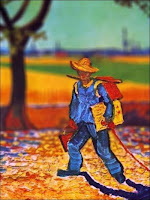
To introduce this focus, students began with a See, Think, Wonder exercise looking and interpreting this 3D computer generated image of Picasso's Painter on His Way to Work.
This computer exaggerated version, shows a hyper representation of the foreground, middle ground, and background elements, illustrating a more accessible example of these perspective elements.
After the see, think, wonder process, students were asked to identify specific objects that are in each of the three "areas." "What do you see in the foreground?" "The middle ground?" etc...

Further we discussed the size of objects in the foreground vs. mid, and background. Students identified that the man in the front is much larger than the buildings in the background (though technically that is not an actual fact). Students noticed that the man and the tree are roughly the same size, though it is a full grown tree.


Next session we applied the See, Think, Wonder exercise to Giovanni Giacometti's Self-Portrait in the Snow, and applied the same identification process of objects/persons in the fore, mid, and background of the painting. Over the following weeks/months, students will consider and explore the visual phenomena of depth and perspective by layering images, layering materials, and constructing a 3D scene using rough scale (small, medium, large) to achieve fore, mid, and background.